3 Features To Look For When Buying Shoes
Do you have orthotics? Sore feet with your first few steps out of bed? Do you suffer with bunions, plantar fasciitis, achilles issues or ankle pain? Or, are you simply a human that wears shoes?
What I’m about to share may surprise you, and will go against everything the big shoe companies keep telling us. These big brands have convinced us our feet are weak and need cushioning and support. What if this was one big lie to sell us more shoes with more technology that cage and ultimately weaken our feet and ankles, only to become ever more dependent on these shoes?
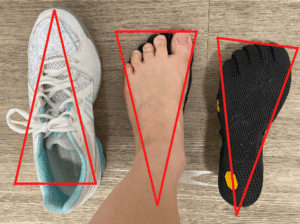
What if many of us unknowingly choose fashion over function? Take a look at
a standard foot and the shoes we put these standard feet into. If you look at our feet, they are shaped like a triangle, with the point at our heel and the base of the triangle at the front of the foot. The
issue is that conventional shoes resemble a bottom heavy triangle, where the triangle base is at our heel and the point is at our toes.
When we squash our upside down triangle feet into a bottom heavy triangle shoe, we disturb the natural movement of our foot. We incapacitate the natural ability of our foot to move by putting them in a cast.
When you look at a conventional shoe you will see:
- Narrow toe box
A shoe with a narrow toe box (the area just behind the toes) squeezes the toes together, causing deformities like bunions, plantar fasciitis and numbness in the toes. We see these issues in the clinic on a daily basis - Lifted heel & Thick sole
A) Lifting the heel shortens the calf and achilles and restricts ankle range of motion, contributing to achilles tendinitis, another issue we treat regularly.
B) Thick and Stiff sole shoes restrict the natural movement of our foot and its ability to sense and adapt to uneven terrain. This disables our proprioceptive system, reducing our stability, compromising our balance and response time and increasing the risk of falls - Strong and high arch support
This can weaken our natural foot strength and contributes to flattened feet. Thats right, having our feet supported externally with arch support or orthotics often weakens the intrinsic strength we have in our feet, flattening them even more. This can then create issues up the chain further, affecting the knees, hips, lower back and on it goes.
But consider this…What if, instead of putting a crutch under our arch, like strong arch support or orthotics, we actually provided an environment where our body could use the intrinsic muscles of our feet and get them working properly to provide stability and protect the supportive tissues including fascia from being tensioned?
So, if not squishing our feet into a narrow shoe that lifts your heel, chocks up your arch and squashes your toes, what else? Walking around barefoot is an excellent option, however sometimes life calls for shoes. Fortunately, there are many forward thinking shoe manufacturers outside the conventional and well known shoe brands that are providing footwear that ticks all the boxes in allowing our feet to move the way nature designed them.
When I’m choosing footwear, the key distinction for me is:
"Does this shoe dictate how my feet move or do my feet dictate how this shoe moves?"
Natural, or barefoot footwear lets your foot act like it would when barefoot while providing a single important benefit - protecting the sole of your foot from damage from rough terrain, sharp objects or temperature extremes.
Watch this video or keep reading...
3 Key Features Of A Great Pair Of Shoes
So here’s the 3 key features to look for in good footwear:
- Wide toe box
This allows the toes to splay, which frees them to wiggle and move which is important for balance and arch function. This allows for more blood flow, optimal nerve function and provides space for the arches to actually support the foot. More width at the front, allows for the upside down triangle shape of our foot and accommodates a wide base of support meaning more contact with the ground and more stability. - Flat & thin sole
A) Flat, meaning there is no ‘drop’ in height from the heel to the toe. Here, the heel and toe are level as if you are standing on bare feet. This optimises calf and ankle function and promotes a more natural running and walking technique.
B) They are Thin, meaning your foot remains close to the ground. This allows for more communication from the 1000s of receptors on the bottom of our feet to our brain. These receptors are constantly sending messages to the brain so we know how to adjust our body position to the surfaces we are on to remain upright. Just like a subaru boxer engine, thinner soles keep you closer to the ground and you're less likely to roll an ankle or fall. In this way, your footwear choice has a significant influence on fall prevention as we age, and therefore our longevity. - Flexible
The shoe has the ability to bend, fold and twist in all directions to allow the foot to move how it needs to move, without compressing the foot or influencing its movement. When our foot is allowed to move naturally, uninhibited by footwear, it will regain its natural strength and mobility to support itself, and the 60+kg on top of it.
Are you ready to stand on your own two feet without orthotics and the high tech support of these shoe companies? Will you give your feet the space so they can move and heal themselves?
Barefoot Shoes
If so, check out barefoot shoes, sometimes called natural, or minimalist shoes. There are various places you can try them on around Brisbane and the Gold Coast. My favourite brands are Leguano, a German brand of every day shoes that are machine washable, Vibram, who make the individual toe shoes that are also machine washable and great for training or bush walks or Vivo Barefoot, who make a wide variety of shoes for movement.
Transitioning to Barefoot Shoes
There are important principals to consider when moving from conventional footwear to minimalist shoes. Many people find that they have sore feet if they transition suddenly from conventional shoes or orthotics to barefoot shoes. It is important to make this transition gradually to support your feet. I explain it to patients like this…Imagine you have never been to a gym before then you went to the gym one day and did 300 bicep curls. Then you went again the next day, and the next. It would be reasonable to expect your bicep to be burning, fatigued and sore. This is what happens to our feet when we take away the artificial support and ask them to work more (or actually start to work). It is like they are going to the gym for the first time. So, be patient, take it gradually and stick with it. Start to move your toes and your feet and ankles more during each day and work on them when you are sitting down.
Here are some ideas to support your transition:
- Go barefoot - Take your shoes off, be barefoot, walk outside 5 min per day on soft grass. Use this opportunity to feel the ground, the temperature and the uneven nature of the surface.
- Toe massage - This is also the perfect way to wake up your toes and restore the communication between your feet and your brain. Fingers are about the width of the space that should be between your toes, so work your fingers backwards and forwards through the spaces between the toes, using oil if you need to.
- Foot massage & mobilisation - Use this combination to release the foot and ankle bones and soft tissues for improved proprioception, balance, shock absorption and to support plantar fasciitis and achilles tendonitis.
- Foot & arch rolling - A comprehensive rolling sequence to release foot muscles to improve foot flexibility, mobility and shock absorption.
- Gradually increase your time barefoot, without conventional shoes or orthotics. Start with light, day to day activities like moving around the house then expand to walking then to more active movements like exercise or training.
If you need specific advice on how to transition to barefoot shoes, chat to us to ease your transition to support the feet that support you.
I hope this has been helpful and opened up the conversation around your footwear.
Written by Dr. Jess Harvey B.Sc. (Anat, Phys), B.Ap.Sci (Comp. Med.), Ma Osteo., Registered Osteopath and Director of Head 2 Toe Health.
We provide Osteopathy, Acupuncture, Massage, Life Coaching and Counselling in Springwood (Brisbane) and Oxenford (Gold Coast). We aim to get you as well as possible, as fast as possible, permanently. We believe in a thorough approach to restoring and maintaining health and address many aspects of our lifestyles that can contribute to pain, stiffness, dis-ease and disease. For any further information, please contact us on info@head2toehealth.com.au or 07) 3208 8308.
This information is intended as a general guide only and is not specific for any particular condition or situation. This information is for educational purposes only. Please seek specific advice for your individual circumstances.